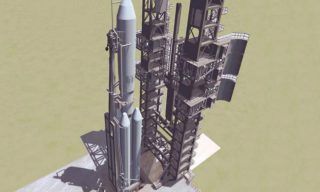
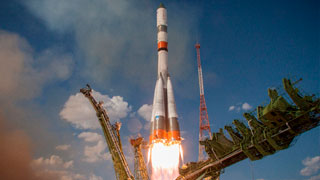


The Soyuz-2.1b rocket was launched from the Vostochny Cosmodrome, located in the heart of the Amur taiga. This cosmodrome has become one of the record holders in terms of the amount of scientific equipment it launches. Its most important part is two satellites that will study plasma in the upper atmospheric layers, magnetic fields, and cosmic radiation as part of the large-scale research project “Ionozond.”
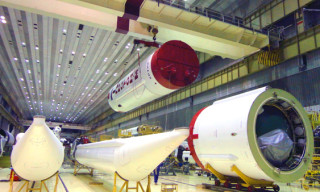
The Soyuz-2.1b rocket was assembled on Friday, and on Saturday it was placed on the launch pad of the newest of Russia’s cosmodromes. Sunday was spent in preparatory work, during which the cosmodrome staff made sure that the entire system was ready for launch.

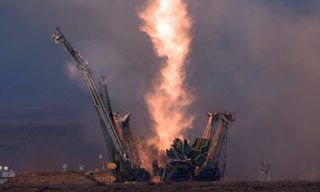
The launch was on schedule – on November 5 at 02:18 Moscow time. The rocket engines turned on, carrying 55 large and small research vehicles into space. It was the 13th launch of a domestic rocket this year, including the third from Vostochny. For Soyuz-2.1b, this flight was the 72nd in a row, and for the upper stages of the Fregat family – 121 for all time.
As reported in Roscosmos, the rocket worked in normal mode, a few minutes after the launch of its upper stage “Fregat” separated from the third stage and began to take the payload into the specified orbits.
Around 4:00 it became known that two satellites “Ionosphere-M” safely reached the target orbit and separated from the “Fregat”. As confirmed in the state corporation, both spacecraft have already taken control. Later, an associated payload consisting of 53 spacecraft (49 of them Russian, one Russian-Chinese, one Russian-Zimbabwean, and two Iranian) was launched into the target orbits.
“Taking into account the Ionosphere-M heliogeophysical satellites No. 1 and No. 2 put into orbit, the simultaneous launch of 51 Russian spacecraft became a record in the history of Russian cosmonautics,” Roscosmos said in a statement.
Ionosphere-M series satellites numbered 1 and 2 (delivered to the spaceport in September) were created with the participation of employees of the Institute of Space Sciences of the Russian Academy of Sciences. These are the first satellites designed within the framework of the Ionozond project. Their main target will be the outer layer of the Earth’s atmosphere, directly passing into the space vacuum – the ionosphere.
The satellites will be engaged in monitoring near-Earth space, including studies of the rarefied plasma located there (primarily wave processes characteristic of it), the Earth’s magnetic field, and its interaction with cosmic radiation. Their observations will be complemented by the SamSat-Ionosphere cubesat, which will measure the density of ionospheric plasma by resonance sounding.
In addition to these satellites, Russian engineers have helped to send into space another 52 satellites, among which are those belonging to Turkey, Iran, and even Zimbabwe. The last one, called ZimSat-2 or AMAISAT, will be engaged in low-Earth orbit to demonstrate communication and surveillance technologies.
Less than a day before the launch, the cosmodrome received for the first time an airplane with Roscosmos CEO Yuri Borisov. Despite very specific weather conditions, the Tu-204-300 successfully landed in the middle of the Far Eastern forests, after which Borisov had the opportunity to personally familiarize himself with the progress of work on the airport complex, which is entering its final stage. Their completion will significantly simplify and speed up logistics, ensuring prompt delivery to Vostochny of satellites, fuel, or upper stages of future reusable rockets.